

What is ISO 27701 PIMS?
ISO 27701:2025 helps organizations manage privacy with clear structure. It supports accountable handling of personal information. It also strengthens governance, trust, and operational discipline.
Today, privacy expectations are rising across every industry. Customers now ask tougher questions. Partners request stronger evidence. Regulators expect more control and better records. Therefore, organizations need a practical privacy management system.
That is where ISO 27701:2025 becomes highly relevant. It extends privacy management into a management system approach. As a result, privacy work becomes planned, assigned, measured, reviewed, and improved. It stops being a loose collection of actions.
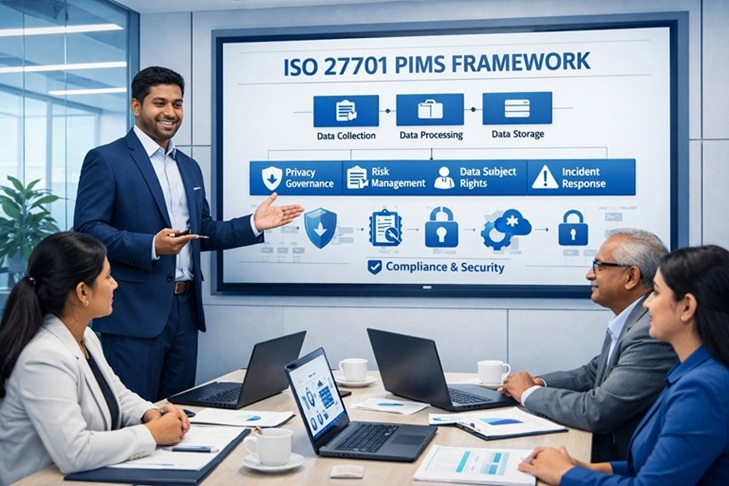
At Inzinc, we offer ISO 27701:2025 consulting services with business focus. We help organizations build a Privacy Information Management System, or PIMS. Moreover, we align it with operational realities. We do not believe in document-heavy projects alone. Instead, we design workable systems.
Many organizations already have ISO 27001 foundations. However, privacy still remains fragmented. Policies may exist. Consent practices may exist. Vendor clauses may exist. Yet accountability often remains weak. Roles may be unclear. Records may be incomplete. Retention may be inconsistent. Response planning may be reactive.
A well-designed PIMS closes those gaps. It gives privacy governance structure. It improves role clarity. It builds process ownership. It also supports better handling of personal data across functions. Consequently, the organization becomes more resilient and more credible.
Benefits of ISO 27701 consulting
- A strong PIMS creates business value beyond compliance. First, it improves customer confidence. Second, it supports partner assurance. Third, it reduces avoidable confusion.
- It also improves privacy governance maturity. Roles become clearer. Responsibilities become assigned. Reviews become structured. Corrective actions become traceable. Therefore, management gains better control.
- Another benefit is stronger risk visibility. Teams identify where personal information enters, moves, changes, stores, shares, and exits. As a result, control gaps become easier to see.
- A PIMS also supports cleaner documentation. Privacy notices, internal procedures, records, retention controls, and incident workflows become aligned. Consequently, staff can work more confidently.
- Moreover, certification readiness improves over time. Audit preparation becomes easier when the system already functions well. Therefore, the organization avoids last-minute scrambling.
- Perhaps most importantly, privacy culture improves. Employees begin to see privacy as operational responsibility. It stops being a legal-only subject. That shift creates lasting value.
Our ISO 27701:2025 consulting approach
- We begin with context understanding. We study your business model, service lines, delivery processes, and data touchpoints. We also identify interested parties and privacy expectations.
- Next, we define the implementation scope. This is important. A weak scope creates confusion later. Therefore, we build a practical and defensible scope.
- Then, we conduct a detailed gap assessment. We review current controls, policies, workflows, vendor practices, and records. We also examine ownership, governance, and evidence maturity.
- After that, we map personal information processing activities. We identify data categories, purposes, roles, transfers, storage points, and control points. Consequently, the privacy picture becomes clearer.
- We then design the PIMS framework. This includes policy structure, control alignment, governance routines, responsibilities, documented information, and review mechanisms. Moreover, we keep implementation practical.
- Next, we support documentation development. However, we do not stop at templates. We also help integrate the system into business processes. That makes adoption more realistic.
- We then guide implementation across departments. This includes awareness, role-based training, record practices, vendor controls, retention, requests handling, and privacy incident workflows.
- After implementation, we support internal review and audit readiness. We help management evaluate system performance. We also help teams close remaining gaps before certification.
- Finally, we support continual improvement planning. A PIMS should evolve with business change. Therefore, we help you maintain momentum after initial implementation.